December 07, 2021

Hospital Is At Home in the Global Village

 In the Global Village, technical advances have enabled Residents to elect home care vs. hospitalization. Remote patient monitoring devices allow physicians to track a patient's heart and breathing rate, weight changes, and activity levels using enhanced telemedicine technology.

 Photo by National Cancer Institute on Unsplash

In the early days of the Industrial Park, it was not unusual for doctors to make "house calls" for those too sick to come to the office and who could not afford hospitalization services. 

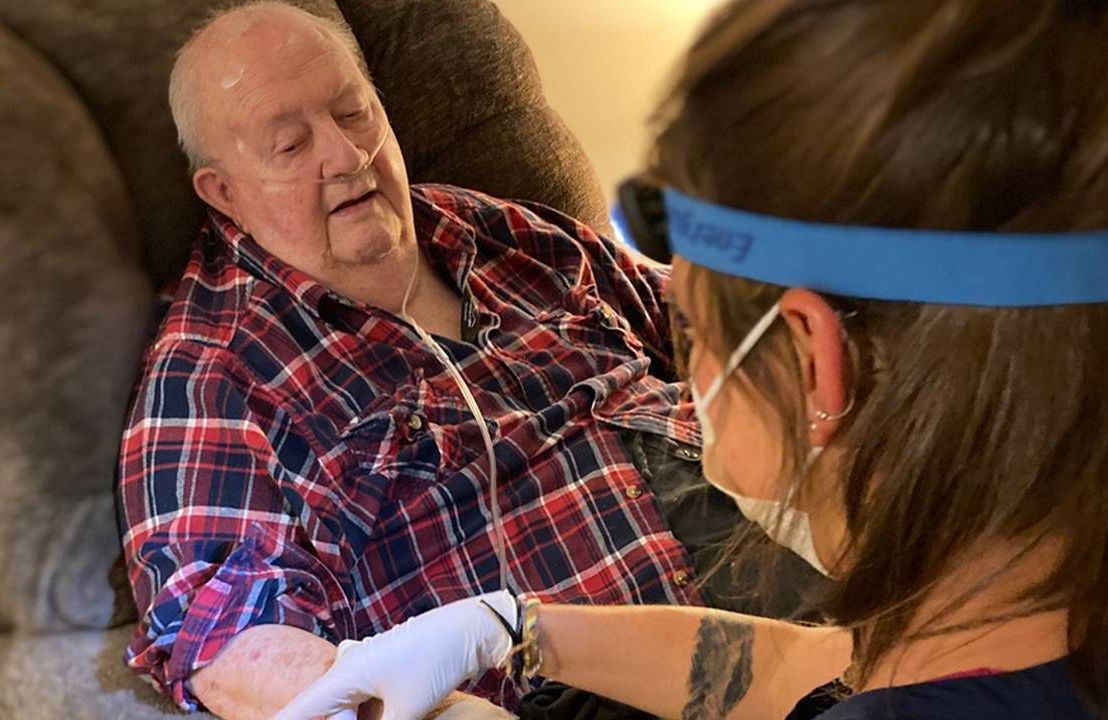
In the early days of the Global Village, it was not unusual for patients to receive hospital-level care in the comfort of their own homes. Although both doctor and patient had to be comfortable with computers, cell phones, and video conference calls, the pandemic provided the impetus to provide hospital care for patients already quarantined at home. 

 A home hospital patient sitting at home in a chair receiving treatment from a nurse. Next Avenue

In the Global Village, providing effective and safe care in people's homes has provided comfort and affordability. Seems like the more things have changed, the more they have remained the same.

That's just the way it is in the Global Village.

November 17, 2021

Legacy Systems

 In the Industrial Park, five legacy systems were the lifeblood of the social order: Governance, Education, Health Care, Finance, and Religion. These systems provided all that was needed to sustain a modern industrial society such as the USA and Europe. They operated in sync with each other and were seldom disrupted by major changes. 

Photo by Terry on Unsplash
 

In the Global Village, these same five systems are rarely in sync and easily disrupted by any fault in the global blockchain that depends on them. They were deployed in the same ways that proved highly effective in the national blockchain that supported the Industrial Park. However, their ability to support global enterprise was severely constrained by cultural and socio-economic differences. From differences in currency valuations, to economic growth and wealth distribution, the global blockchains were incoherent and unpredictable.

Residents of the Global Village were able to overcome these constraints by applying a combination of  Consumerism and Autonomous Socialism. Because they are guided by Artificial Intelligence, both of these global systems are blind to currency fluctuations, cultural differences and socio-economic variations. The technology platforms that support these global systems are vetted and rated by all stakeholders in the Global Village. Unanimous approval is required to add functionality or change the basic design. The Prime Directive provides the success criteria for any changes: 

  • Serve all Residents equally well.
  • Provide win-win solutions to all global problems
  • Preserve, protect and defend the rights of all Residents 

November 12, 2021

Autonmous Socialism in the Global Village

 The human economy is not going to disappear completely by 2030, but the autonomous economy is going to eat into it more and more each year. Robotics are going to displace manual labor and faulty decision-making. AI enabled smart contracts are going to replace intelligent labor, such as lawyers, accountants, third party intermediaries, data entry positions, and insurance adjusters. It’s just the beginning too, as an immense amount of developers are likely to start flocking towards developing AI algorithms and smart contracts. The more people that get involved, the more velocity the movement gains.

 Photo by Adi Goldstein on Unsplash

What will change is how the economy of the Global Village distributes resources. Economic progress during the Industrial Park era was, by nature, a zero sum game.  Captains of Industry emerged out of the struggle for wealth by doing whatever it took to capture the available resources in their playing field. They may have risked their personal wealth to provide the capital required to start new ventures but, once their venture took off they encountered few restraints on their power to control the labor and raw materials needed to grow their business. For every winner, there had to a be a  loser. Laborers were especially vulnerable because they were expendable. Not until the turn of the Century were they able to form Unions and garner political capital.  Even then, politicians at all levels of government tended to follow the money rather than the will of their constituents. 

However, AI entities have no need for wealth or power. They simply perform the simple or complex tasks for which they were designed. This unique quality enables them to deploy wealth and resources, just in time, to where they are needed. Waste and inequality become a thing of the past. Yes. This was the ideal of the Socialism that evolved at the turn of the 20th Century. However, the fair and equal distribution of resources was still left in the hands of human beings, who were prone to favor the wealthy and powerful. So the  term socialism became synonymous with totalitarian rule and was rejected by Residents of the Global Village. This attitude persisted until Residents began to realize that most, if not all, tasks performed by government officials could be replicated by robots. Not the kind of robots seen in movies or described in Science Fiction novels. These robots were electronic control networks capable of performing millions of transactions precisely and efficiently. They can fly planes, drive cars, control our household appliances and diagnose diseases with the precision of the best pilots, car drivers, and medical practitioners. They can also manage our finances and optimize our daily schedules. Because they are part of a Global Network, their services are not limited by geography nor at the mercy of local politicians. They are autonomous servants, programmed to distribute wealth and resources with equality while enabling their "constituents" to enjoy life, liberty, and pursuit of happiness in the Global Village.     

February 22, 2021

Middle Class in the Global Village

The increase of WFH jobs will not create a new class system but, it will transform the Middle Class as we knew it.


Photo by Jeswin Thomas on Unsplash

 What we are experiencing in the Present is exactly what Alvin Toffler forecast in Future Shock and Powershift. The Industrial Park of the 20th Century spawned the Middle Class. These were the people who served industry as “middlemen”. They linked producers with consumers; they linked government agencies with the people they served; they linked educators with students; they linked doctors with patients; they linked civil service with the military service; and they linked financial resources with investors.


In the 21st Century, most of these Middle Class careers are giving way to AI-guided automation. Unlike the geophysically constrained tasks in the Industrial Park, the middleman tasks in the Global Village have no geophysical limits. They can be handled remotely from anywhere. This does not mean that all these Middle Class careers go away. It means that they will be repurposed. Some will be employed to develop the SW applications required to track transactions; others will be employed to implement these applications on a global scale; and still others will be employed to maintain them. All will be hired as independent contractors who will negotiate their payment based on their value rating. Some will easily command a 5-star fee, others will garner average fees. Most will remain in the middle and that will define the Middle Class of the 21st Century.

The human economy is not going to disappear completely by 2030, but the autonomous economy is going to eat into it more and more each year. Robotics are going to displace manual labor and data driven decision-making. AI enabled smart contracts are going to replace intelligent labor, such as lawyers, accountants, third party intermediaries, data entry positions, and insurance adjusters. It’s just the beginning too, as an immense amount of developers are likely to start flocking towards developing AI algorithms and smart contracts. The more people that get involved, the more velocity the movement picks up.


$tokens for the GVO Curator

January 16, 2021

Socioeconomic Systems of the Global Village


Whereas data is the fuel for intelligence, the brain is the engine that takes in data, cross-references it with previous data, sorts it into categories, makes judgments, triggers actions in the real world, and puts it into storage.
 

Replicating the human brain is very complex and difficult to master. However, breakthroughs are beginning to take place in the Global Village that will give Residents the ability to mimics human intelligence in some form. As this ability increases, the socioeconomic elements that enabled the Industrial Park model will fade away. As they fade, socioeconomic elements with a global reach will replace them across the Global Village.
  
According to Adelyn Zhou, a leading voice in AI, there are seven of these  of AI elements:
 
Act- systems that act based off rules like a smoke detector or cruise control.

January 14, 2021

The Global Village Code of Conduct.

There are no bars to entry in the Global Village. Anyone is welcome to reside here regardless of their mental acuity or physical dexterity. There is a global need for just about every skill and every cache of actionable knowledge that sustained the Industrial Park. However, all Residents are expected to adhere to the Global Village Code of Conduct.

Photo by John Cameron on Unsplash

The Global Village Code of Conduct coves the following topics:

ETHICAL PRINCIPLES - includes on-line behavior and respect for all Residents

January 04, 2021

Getting Educated in the Global Village - Phase 2

During Phase 1 of the transition from the Industrial Park model to the Global Village model, educators were forced to question long-standing assumptions and develop strategies that were both affordable and available. Those strategies forced school administrators to distinguish between the superfluous and the essential elements of getting educated in the Global Village. Phase 2 applied Lessons Learned during Phase 1 to create a robust and sustainable system of education for the Global Village. This involved five basic principles:


Photo by Mohammad Shahhosseini on Unsplash


1. Restructuring time 

In the Industrial Park, time was the constant and learning was the variable. In the Global Village,  learning is the constant and time is the variable. Though far from optimal, the way students got educated during the pandemic helped break the bond to outdated time structures for learning.

2. Student-centered models 

In the Industrial Park, education occurred in batch-mode. This aligned with the protocols for  factory, and industrial operations. However, these protocols could  not accommodate the special needs, learning challenges, or disparities among batches of students. Affluent parents could  mitigate these obstacles with private tutors, and teacher assistants.  Students whose parents could not afford these options fell  behind and seldom recovered. The batch mode of education required lock-step performance. Out of step performers reflected poorly on the "productivity" of the education factory.

January 03, 2021

Dual Residency in the Global Village

 All Residents of the Global Village enjoy dual residency.

  •  Their IP address makes them bona fide residents of the Global Village. 
  •  Their Land address makes them bona fide residents of the community where they reside.


Benefits, Privileges, and Drawbacks 

Dual residency offers benefits and privileges in each space where you reside. For example, you will have access to two support systems, can influence others in both spaces, and may be able to attain leadership roles in both. You are also able to work in either space without needing a work permit or visa. And you can attend school in either space at the tuition rate offered for both on-line and in-person classes.

  • Dual Residents have the ability to live and work freely in their own homes, subscribe to on-line and in-person entertainment, and take virtual tours of distant places with relative ease.
  • Drawbacks of being a dual resident include the potential for double taxation, the concern for security in both spaces, and the fact that you become bound by the laws and codes of both spaces.
  • Attaining dual residency in some locations can be complex and expensive. It may require the assistance of both legal and technical experts approved by Government Authorities.

Cultural Education

Dual Residents have the opportunity to learn about the culture of countries they may never see in person, learn two (or more) languages, and experience different ways of life.

Both social media and in-person relationships can be complex when the rules regarding citizenship and on-line participation are controlled by Government Authorities. In these cases, it may be wise to consult with certified experts–including technicians and lawyers–regarding the do's and don'ts of work from home employment and social media restrictions.


$tokens for the GVO Curator

Neuroscience in the Global Village

  By 2030,  mental illness had so plagued the Global Village that the regard for Clinical Psychologists and Psychotherapists was the lowest ...