#globaleducation
As our culture transitions from the Industrial Park to the Global Village, the learning environment is changing radically. The Industrial Park classroom placed a “teacher” at the front of the classroom, as the focal point for students' attention. In the Global Village, the classroom is a virtual landscape in which the learner may be accessing information from multiple sources. The teacher is only one of these sources.
These changes may seem threatening. Certainly, they are challenging. It is difficult for traditional classroom teachers to know how best to convey lessons in which students are using a variety of devices for taking notes and instantly googling concepts that are unfamiliar. Some students may even drift off to messaging and playing games. For the typical classroom teacher of the Industrial Park era, “paying attention” was the prime directive for good grades and success in their classroom. The unspoken directive was to keep pace with the rest of the class even if you had difficulty processing the information being presented. Following behind was considered the consequence of not paying attention--never the result of a learning disorder. Students were viewed as widgets on the assembly line of knowledge infusion. What worked in the factory, should work equally well in the schoolhouse. Or so they thought...
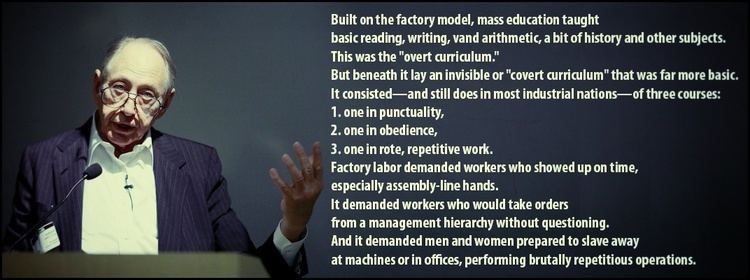
At the start of the 21st Century, the assembly line worker collided with automation. Likewise, the classroom teacher collided with remote learning. Both were forced to rebalance their roles and learn how to cooperate with this wave of technological change.
The concept of extending our sensory perceptions via technology and the subsequent need for rebalancing was explored by Marshall McLuhan in Understanding Media: The Extensions of Man. He suggests that a technology “extends” human capabilities and, in doing so, requires humans to rebalance their senses. An analogy for this concept could be the idea of a lever, which extends human strength (literally the human arm) but requires the human to take a position which balances the force being exerted on the lever. Should the resistance suddenly subside, the person using the lever would fall forward.
When the extensions are sensory, the balances are not so visible. McLuhan, suggests that electricity extends the nervous system outside the human body. Electricity, which powers artificial light and digital information transfer, creates technologically produced levels of stimulation. This stimulation requires humans to rebalance their sense ratios. With technologies that extend human awareness, humans, in terms of their senses, begin to inhabit more than one place. The consciousness of a student googling and typing notes on a laptop, is both in the classroom and in the virtual location of the Google search. The result is a necessary reallocation of sensory resources, such as peripheral awareness.
Those of us who use any technology that extends our consciousness, voice or memory, must constantly rebalance our senses. We have to change our physical, emotional and intellectual position in order to balance stimulation that we experience through our extended senses. Even the act of turning off the device will require rebalancing since turning it off will change the forces that were working in our minds when the device was active. As with the lever, if resistance gives way suddenly, a person can tip over. That is why telling someone to turn off their device does not immediately enable that person to pay attention. The point is, whether the devices are on or off, the person who uses the device is still extended into them and is still having to balance and rebalance due to their stimulation or the removal of that stimulation.
The global classroom, links the virtual world with the human world. The virtual world, for all its convenience and recreational interactivity, is a place of fixed relationships – the information remains implacably what it is, programs will do only what they are programmed to do. The human who has varying perceptions and needs can be frustrated with a program’s inability to respond to subtle adjustments in the query. The human world, on the other hand, can accommodate both flexible and multidimensional communication.
Little could McLuhan have envisioned, when he coined the term “Global Village” in 1962, the virtual profile many global classrooms have conjured up beyond their campuses and countries. Students everywhere can interact on-line leading to collision or cooperation. The outcome of this experience can determine the future of the global classroom. Will it lead to an new era of tolerance and cooperation, or to an era of constant collision and disassociation?
In the words of Northrop Frye, language differences by their nature, reflect and produce perceptual differences. The fact that our shared learning space conducts its discussions in English does not (and should not) eradicate the perceptual differences that students are bringing to the process of developing knowledge. These differences are an asset.
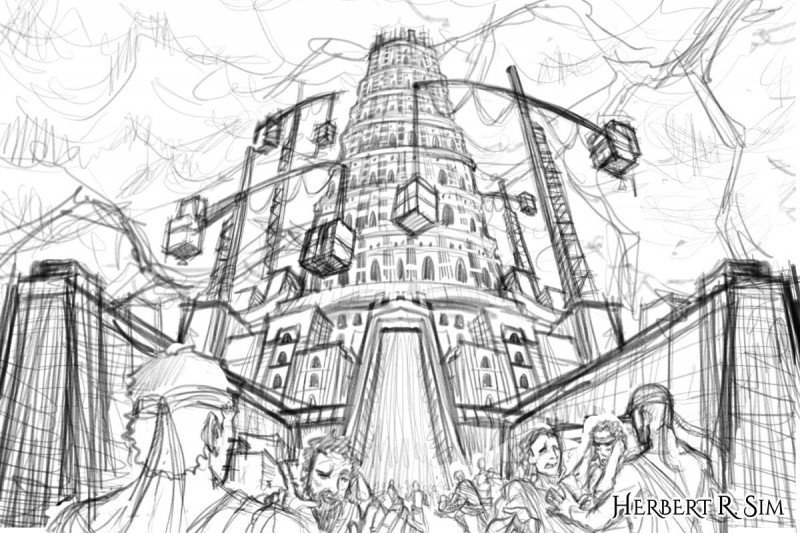
The particular myth that's been organizing this talk...is the story of the Tower of Babel in the Bible. The civilization we live in at present is a gigantic technological structure, a skyscraper almost high enough to reach the moon. It looks like a single world-wide effort, but it's really a deadlock of rivalries; it looks very impressive, except that it has no genuine human dignity. For all its wonderful machinery, we know it's really a crazy ramshackle building, and at any time may crash around our ears. What the myth tells us is that the Tower of Babel is a work of human imagination, that its main elements are words, and that what will make it collapse is a confusion of tongues. All had originally one language, the myth says. The language is not English or Russian or Chinese or any common ancestor, if there was one. It is the language that makes Shakespeare and Pushkin authentic poets, that gives a social vision to both Lincoln and Gandhi. It never speaks unless we take the time to listen in leisure, and it speaks only in a voice too quiet for panic to hear. And then all it has to tell us, when we look over the edge of our leaning tower, is that we are not getting any nearer heaven, and that it is time to return to earth. --― The Educated ImaginationIn collision and cooperation, students in the Global Classroom learn from one another and so increase the potential of the Global Village. Residents have been intuitively moving forward on these two fronts: implementing new technological teaching tools, and developing innovative ways to balance these impersonal methods. By “throwing together” students and teachers from all over the world, Residents are gaining a clearer understanding of how these forces balance, enable and/or augment one another.


No comments:
Post a Comment
I am a knowledge cowboy at home on the range of human thought and imagination. I round up stray thoughts as I drive the herd toward the Information Market. Add your thoughts here.