December 27, 2020

The Gig Economy in the Global Village

The term “gig economy” was first coined by journalist Tina Brown in 2009. She wrote about the trend of workers pursuing “a bunch of free-floating projects, consultancies and part-time bits and pieces while they transacted in a digital marketplace.” To sum up, Gigs are either knowledge-based assignments or need-based tasks.

Photo by Mathieu Stern on Unsplash


The Global Village economy runs on the principles of Consumerism. Everyone is a producer and likewise everyone is a consumer. Gigs are the primary means of value exchange

The gig economy is made up of two main components: the independent producers paid by the gig (i.e., a task or a project); the consumers who need a specific service, for example, a ride to their next destination, or a particular item delivered. The bedrock of the Consumerism model is the balancing mechanism that is not dependent on Government or Third Party control to function . Instead, it uses Big Data and Consumer Surveillance technology to maintain the balance between producers and consumers.

In the Global Village, every resident is both a consumer and a producer. One Resident needs plumbing service, another Resident provides the service. This transaction is automatically recorded by the Village Consumer Surveillance (VCS) application.; and a conglomeration of companies that connect the producer to the consumer in a direct manner, including app-based technology platforms such as Uber, Airbnb, Lyft, Etsy or TaskRabbit. Together they act as the conduit through which the producer is connected to – and ultimately paid by – the consumer. These companies make it easier for Residents of the Global Village to sustain themselves as both producers and consumers, which can include any kind of work, from a musical performance to fixing a leaky faucet. One of the main differences between a gig and traditional work arrangements, however, is that a gig is a temporary work engagement, and the producer is paid only for that specific gig. 
Manufacturing, construction, and infrastructure maintenance projects are the purvey of traditional corporations and communities. In this respect, Residents of the Global Village can have dual citizenship with an IP address and a land address. 

The 21st Century growth of the gig economy was driven by the development of new technologies that enabled transactions directly between providers and consumers.  On the one hand, app-based technology platforms are replacing people as middlemen to connect consumers and producers quickly and easily, allowing individuals to perform a variety of tasks for complete strangers based on real-time demand. On the other hand, people are increasingly gravitating toward Consumerism either to supplement their traditional income or to pioneer new sources of income that are less prone to recessions and inflation.

Intuit and Emergent Research have predicted that “the number of people working on-demand [gig] jobs would grow from 3.9 million Americans in 2016 to 9.2 million by 2021.”7 The pandemic has exacerbated this growth. To accommodate and nurture it, communities transitioning from the collapsing Industrial Park model to the Global Village model must support both producers and consumers in this transition. This requires new ways of funding public services such as education, health care,  and safety. It will also disrupt the ability of Federal, State, and Local Governments to impose taxes using a structure designed for the Industrial Park. Residents of the Global Village are not tied to a particular community or geographic location for their sustainence. So they will likely gravitate to physical locations that offer the best value. Talking about how to tax them is like trying to make a better buggy whip when automobiles became commonplace. Perhaps an annual "residency" fee would be a better fit for their itinerant lifestyle? 


December 25, 2020

The Evolution of the Global Village

#globality 

There were positive effects of the 2020 Pandemic. It exposed the vulnerabilities of a global,  complex  supply chain that could be so easily unbalanced. Once again both capitalism and socialism failed to stand up to a global threat. Neither system could embrace the synergistic cooperation needed to pull the entire globe out of the quicksand of total collapse. The capitalist societies competed with each other for limited financial and material resources. The socialist societies rationed those resources to the point of diminishing returns for everyone alike. Neither side knew how to rise above the legacy of the Industrial Park and balance the disparity on a global scale.


Eventually,  Resident leaders evolved who were able to co-create and reengineer the institutional, industrial and socio-economic fabric of the emerging Global Village. The pandemic brought disparity and suffering to everyone alike. This could not be mitigated by competition. That would be like beating a dead horse. Nor could it be mitigated by spurts of cooperation. That simply led to rationing and eventually, extinction. 

There were many benefits to having separate countries around the world. Each group could preserve its  culture and help spawn new industries. But the biggest benefit to the Industrial Park was the innovation spurred by competition between countries. This competition helped push the nominal standard of living to increasingly higher levels. However, by 2020 the world was in dire need of a trusted consortium of global authorities able to  address converging global issues such as climate change, food insecurity, and wealth inequality. Without such a trusted entity, problems would fester until the planet imploded into global warfare and social dysfunction. The relationship between the Global Village and Global Real Estate is symbiotic. If the real economy collapsed, the Internet of Things  would go down with it.

December 23, 2020

Christmas Dinner in the Global Village

Click here for  Carols from Berlin


$tokens for the GVO Curator

December 20, 2020

Getting Educated in the Global Village - Phase 1

The worldwide pandemic forced schools to rethink traditional face-to-face learning and unwillingly transition from the Industrial Park schoolhouse to the Global Village accessed from home.  So, while there may be no schoolhouses in the Global Village, the pandemic has amplified every weakness in an education process based on the 20th Century Industrial Park model. These issues are being addressed in Phase 1 of the Transition.

While some schools have been creeping toward blended learning models that combine face-to-face learning with online learning, this requires the presence of both teacher and student at the same time. However, unlike the Industrial Park classroom, the student has some control over time, pace, and place. By pivoting to full online learning, school administrators are also discovering the many inequities associated with the Global Village model. Unless Residents of the Global Village can deal with childcare and accessibility issues, their children will be forced to get educated via  the  failed Industrial Park model once the pandemic is over. 


Photo by Kelly Sikkema on Unsplash

When children participate in remote learning from home, many parents have to choose between work and home. Someone must stay at home with children while they attend virtual school. That someone is usually the mother. Since businesses have failed to step up and provide daycare while schools remain closed, this problem will constrain schools from moving to a fully remote school day--even if this proves to be as effective as in-person learning. In addition to childcare complications, school administrators must also find ways to solve the accessibility and equity issues. 

Disadvantaged youth do not have access to Wi-Fi or telecommunication devices. Although many schools provide devices and hot spots, not all schools can afford to do this. High speed internet along with up-to-date devices are out of reach for many families and underfunded school districts. This issue also affects rural communities that often do not have internet access. The closest hot spot might be an hour’s drive. So, until Wi-Fi is available and affordable wherever needed, school administrators will be reluctant to abandon the heritage schoolhouses of the Industrial Park.

Now, Residents of the Global Village must ask themselves, "How will our children get educated on the road ahead? If stakeholders are willing to make transformative change, schools can become hubs for students to communicate, collaborate, debate, and discuss. Students will get educated at home using pre-recorded on-demand  modules with the support of a homeschooling assistant. On social interaction days, students may be bused to gatherings at sporting events, camps sponsored by the "Y" or traditional dances, proms, and plays.

Knowledge and skills gained in the traditional school setting can be learned at home. But, social skills, team building, and leadership, require student interaction. These skills form the soul of the Global Village. They cannot be accomplished in quiet isolation, social media activity, or gaming competition. 

Children must learn how to work with a variety of peers and adults. They must encounter diversity, work through disagreements, and build relationships. The future of education will require students to learn the majority of the information at home and then build skills related to collaboration, emotional intelligence, and team building when they interact with others in their local community.

Students may no longer need to follow a bell schedule, elect a prom queen, or attend a pep rally. However, school administrators must provide students with the type of interactions that allow them to learn from each other, work together, and solve problems.

Now that schools have had to pivot to full online learning, they are discovering the many inequities associated with this model. Until school administrators can deal with childcare and accessibility issues, schools will return to using the failing traditional face-to-face model once the pandemic is over. 

In addition to childcare complications, school administrators must also find a way to solve the issues related to accessibility and equity. Disadvantaged youth do not have access to Wi-Fi or devices. Although many schools provide devices and hot spots, not all schools can afford to do the same. High speed internet along with up-to-date devices are a high cost for families and/or school divisions. This issue also affects rural communities that often do not have internet access, and the closest hot spot might be an hour’s drive. So, until Wi-Fi is available and affordable everywhere it is needed, school administrators will be reluctant to abandon the legacy of the Industrial Park model.

Much of the information learned in the traditional school setting is easily learned from home. But, the social skills, collaborative skills, problem-solving, and critical thinking occur when students interact. These skills are needed in the workplace and cannot be accomplished while working individually or even with the same small group of students.

Children must learn how to work with a variety of peers and adults. They must encounter diversity, work through disagreements, and build relationships. The future of the Global Village may require young Residents to acquire an elementary education at home. But building collaborative skills, emotional intelligence, and the ability to lead others must occur in their local community.

Industrial Park traditions such as  following bell schedules, electing  prom queens, and mandatory attendance at pep rallies will fade into the forgotten past over time.  However, school administrators in the Global Village must  provide opportunities for students to learn from each other, work together, and become valued citizens of both their local community and the Global Village.


$tokens for the GVO Curator

December 10, 2020

Governance in the Global Village

 #globality

 A governance model outlines how people in authoritative positions hold themselves accountable to their stakeholders

. Governance models incorporate ethics, integrity, and a responsible code of conduct for all leaders, volunteers, and workers. Residents of the Global Village have chosen a hybrid  derived from two models commonly utilized by the Industrial Park:

  • Advisory Model. The advisory board is one of the most traditional styles of nonprofit governance used in the Industrial Park
  • Cooperative Model. Although somewhat uncommon in larger nonprofit organizations, a cooperative board is one where all members make consensual decisions as equals. 

Although originally developed to govern nonprofit institutions, these two models best fit the servant-leadership mentality of Global Village leadership. Leaders are trusted servants empowered, as needed, by the communities they serve. They may serve in an advisory capacity when their expertise matches the needs of an on-line community such as telemedicine or crisis counseling. They may serve as a judge on a Global Village Tribunal if requested to arbitrate a dispute.    

Good governance has 8 major characteristics. 'It is participatory, consensus-oriented, accountable, transparent, responsive, effective and efficient, equitable and inclusive and follows the traditions and practices embedded in the Global Village Code of Conduct.

The Global Village Code of Conduct consolidates the key governance practices adhered to by all Residents including:  Role descriptions for Trusted Servants.

The Code of Conduct  breaks role descriptions into four simple words: People, Purpose, Process,and Performance. These are the Four Ps of governance in the Global Village. 

The Code also defines the guiding philosophy behind the Global Village Adhocracy of well-educated and qualified individuals. They deliver highly specialized and valuable services for which they are appropriately compensated. A key principle of the Global Village adhocracy is the autonomy of its agents. All are assumed to be sufficiently expert to make timely choices in the actions they undertake on behalf of Residents.


$tokens for the GVO Curator

November 28, 2020

Post-Industrial Society in the Global Village

#globality

To understand life in the Global Village, think about how our nomadic ancestors lived:

Hunter-gatherers lived in a society in which most or all their needs were obtained by foraging for wild foods. Until about 12,000 to 11,000 years ago, when agriculture and animal domestication emerged in southwest Asia and in Mesoamerica, all peoples were hunter-gatherers. Their "villages"  were mobile and dependent on the availability of indigenous resources. When they exhausted those resources, they moved on.

Hunter-gatherers harnessed the use of fire, developed intricate knowledge of plant life and refined technology for hunting and domestic purposes as they spread from Africa to Asia, Europe and beyond.

 Some were able to find places of abundance where they could settle in small villages close to those resources. Over time, they became less dependent on foraging. Instead, they bred animals and cultivated wild plants for food. That knowledge was a game changer. It enabled the small villages to grow and for residents to specialize in tasks such as ranching and farming. 

Fast-forward a few thousand years, and we find a highly specialized culture where ranching and farming have become an industry. This industry was supported by automated machinery produced in factories that employed hundreds of workers. The villages have evolved into large cities of workers who are sustained by the industries they serve. At first, most factories were embedded in residential areas. Then the noise and pollution produced by those factories induced the residents to separate the factories from the residential areas. Thus was born the Industrial Park. 

Initially, the Industrial Park was a short commute from home. However, the increased demand for homes close to the Industrial Park drove prices up and forced the average worker to move further and further away from their job location. The short commute became a longer commute. With more people commuting came the need to build more and better roads. Two-lane highways evolved into four and even six lanes. The improved highways encouraged more workers to "move to the country" for cheaper housing and better living conditions. Soon this whole process began to reflect the industrial mentality that launched it. That opened the door to data-controlled automated processes. Soon every aspect of life was subject to these processes. There were "work time" processes, "family time" processes, and for many "wartime" processes. Daily living became more complex than the average person could handle without the support of machines. From automobiles to commuter trains, from home appliances to medical equipment, from work machinery to entertainment; every aspect of life required machine assistance.

Machines must be programmed to perform the function required. In the simplest terms, programming meant designing processes to guide the machine. Process design required data input. The engineer or designer used data to tell the machines what users expected them to do. So an automobile must go forward or backward under its own power. A wash machine must use water and soap to wash clothes. A rifle must propel lead bullets at a target. Beyond the basic function the designer needed to know "how fast" the auto should go; "how much water" the wash machine required and "how far" the lead bullet must propel. The engineer/designer used a four-step process comparable to the hunting/gathering process of our ancestors.

1) Gather data
2) Process the data using previous data as reference
3) Take action based off the refined data
4) Receive feedback data, learn from the result, and store it all in memory.
Patterns not only point out what works vs. what doesn’t work, strengths vs. weaknesses, and trends vs. anomalies, but it helps people categorize information so it’s easy to remember for future use.
 
As Albert Einstein once said, “The measure of intelligence is the ability to change.” The only way someone is going to change is by being exposed to a negative pattern holding them back or see a better pattern to get ahead. The last step is implementation through will power and action. 
 
In the Industrial Park, the engineer/designer provided that will power and action.

In the Global Village, technology  replicates the intelligence of the engineer/designer and develops it into a digital commodity sold on the open market.  But it must still be harnessed using the same model as our primitive ancestors.  Utilizing advancements in hardware, software, and data technology is on the verge of manufacturing intelligence. The autonomous economy is the growth engine in the Global Village.
 
The Internet of Things (IoT):
 There are really two categories of data: public data and private data. The Internet is the largest warehouse of public data and is unique because it’s an ever-increasing resource. Private data is mostly concentrated on private servers, especially in Clouds, and contains sensitive information that people either don’t want to freely share or don’t want seen. It shouldn’t really be surprising anymore that many of the largest companies in the world own the most data, like Google, Facebook, Amazon, and Baidu. 
The Global Village is the master host of all applications that Residents use daily. Data metrics are gathered passively as Residents  go about their daily life. In the Industrial Park, real-time data was hard to come by, but  thanks to major innovations in sensor and actuator technology, that is not the case in the Global Village. All types of sensor activity is possible, such as sensors that measure temperature, location, speed, acceleration, depth, pressure, blood chemistry, air quality, color, photo-scanning, voice scanning, biometrics, electric, and magnetic force. Normally, humans are required to take such measurements, but that is quickly changing due to the availability of  accurate sensors and actuators. They’re not only placed in the environment, but are embedded in  machines, robots, and even worn by humans. This river of real-time information flows constantly. The only way that autonomous action is effective is if it can respond quickly with confident judgments. The ability to monitor intricate details in real-time about every aspect of life in the Village is transformational on many levels. Essentially, everything, both physical to non-physical, is being brought online as data into an interconnected web, hence the name, the Internet of Things. It’s the human senses in digital form. Or, as Marshall McLuhan might say, the senses of every Resident in the Global Village are now extended to every nook and cranny of the entire Village.
 
  $tokens for the GVO Curator

November 14, 2020

Collision vs Cooperation in the Global Classroom

 #globaleducation

As our culture transitions from the Industrial Park to the Global Village, the learning environment is changing radically. The Industrial Park classroom placed a  “teacher” at the front of the classroom, as the focal point for students' attention. In the Global Village, the classroom is a virtual landscape in which the learner may be accessing information from multiple sources. The teacher is only one of these sources. 

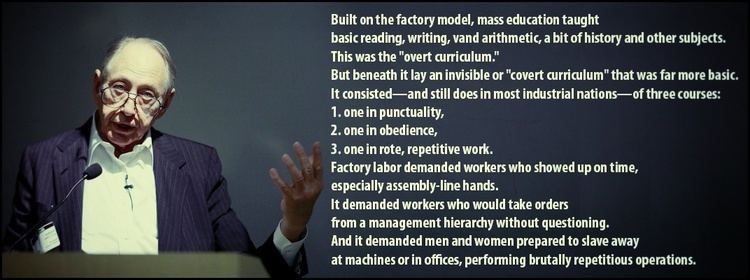
These changes may seem threatening. Certainly, they are challenging. It is difficult for traditional classroom teachers to know how best to convey lessons in which students are using a variety of devices for taking notes and instantly googling concepts that are unfamiliar. Some students may even drift off to messaging and playing games. For the typical classroom teacher of the Industrial Park era,  “paying attention” was the prime directive for good grades and success in their classroom. The unspoken directive was to keep pace with the rest of the class even if you had difficulty processing the information being presented.  Following behind was considered the consequence of not paying attention--never the result of a learning disorder. Students were viewed as widgets on the assembly line of knowledge infusion. What worked in the factory, should work equally well in the schoolhouse. Or so they thought...

Alvin Toffler Alvin Toffler Quotes QuotesGram

At the start of the 21st Century, the assembly line worker collided with automation. Likewise, the classroom teacher collided with remote learning. Both were forced to rebalance their roles and learn how to cooperate with this wave of technological change. 

The concept of extending our sensory perceptions via technology and the subsequent need for rebalancing was explored by Marshall McLuhan in Understanding Media: The Extensions of Man. He suggests that a technology “extends” human capabilities and, in doing so, requires humans to rebalance their senses. An analogy for this concept could be the idea of a lever, which extends human strength (literally the human arm) but requires the human to take a position which balances the force being exerted on the lever. Should the resistance suddenly subside, the person using the lever would fall forward.
 

When the extensions are sensory, the balances are not so visible. McLuhan, suggests that electricity extends the nervous system outside the human body. Electricity, which powers artificial light and digital information transfer, creates technologically produced levels of stimulation. This stimulation requires humans to rebalance their sense ratios. With technologies that extend human awareness, humans, in terms of their senses, begin to inhabit more than one place. The consciousness of a student googling and typing notes on a laptop, is both in the classroom and in the virtual location of the Google search. The result is a necessary reallocation of sensory resources, such as peripheral awareness.

37 Alvin Toffler Quotes That Are So Relevant

Those of us who use any technology that extends our consciousness, voice or memory, must constantly rebalance our senses. We have to change our physical, emotional and intellectual position in order to balance stimulation that we experience through our extended senses. Even the act of turning off the device will require rebalancing since turning it off will change the forces that were working in our minds when the device was active. As with the lever, if resistance gives way suddenly, a person can tip over. That is why telling someone to turn off their device does not immediately enable that person to pay attention. The point is, whether the devices are on or off, the person who uses the device is still extended into them and is still having to balance and rebalance due to their stimulation or the removal of that stimulation. 

The global classroom, links the virtual world with the human world. The virtual world, for all its convenience and recreational interactivity, is a place of fixed relationships – the information remains implacably what it is, programs will do only what they are programmed to do. The human who has varying perceptions and needs can be frustrated with a program’s inability to respond to subtle adjustments in the query. The human world, on the other hand, can accommodate both flexible and multidimensional communication.

Little  could McLuhan have envisioned, when he coined the term  “Global Village” in 1962, the virtual profile  many global classrooms have conjured up beyond their campuses and  countries. Students everywhere can interact on-line leading to collision or cooperation. The outcome of this experience can determine the future of the global classroom. Will it lead to an new era of tolerance and cooperation, or to an era of constant collision and disassociation?


In the words of Northrop Frye, language differences by their nature, reflect and produce perceptual differences. The fact that our shared learning space conducts its discussions in English does not (and should not) eradicate the perceptual differences that students are bringing to the process of developing knowledge. These differences are an asset.

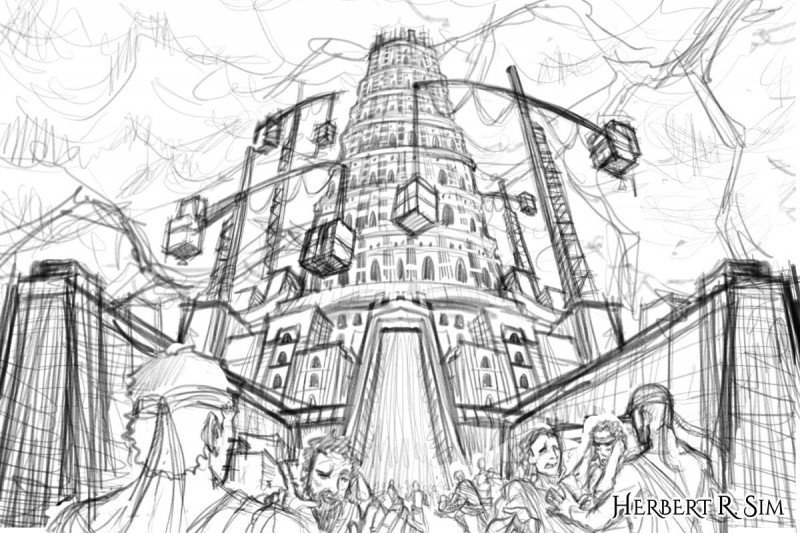
The Confusion of Languages at the Tower of Babel - Herbert R. Sim

The particular myth that's been organizing this talk...is the story of the Tower of Babel in the Bible. The civilization we live in at present is a gigantic technological structure, a skyscraper almost high enough to reach the moon. It looks like a single world-wide effort, but it's really a deadlock of rivalries; it looks very impressive, except that it has no genuine human dignity. For all its wonderful machinery, we know it's really a crazy ramshackle building, and at any time may crash around our ears. What the myth tells us is that the Tower of Babel is a work of human imagination, that its main elements are words, and that what will make it collapse is a confusion of tongues. All had originally one language, the myth says. The language is not English or Russian or Chinese or any common ancestor, if there was one. It is the language that makes Shakespeare and Pushkin authentic poets, that gives a social vision to both Lincoln and Gandhi. It never speaks unless we take the time to listen in leisure, and it speaks only in a voice too quiet for panic to hear. And then all it has to tell us, when we look over the edge of our leaning tower, is that we are not getting any nearer heaven, and that it is time to return to earth.  --― Northrop Frye, The Educated Imagination
In collision and cooperation, students in the Global Classroom learn from one another and so increase the potential of the Global Village. Residents have been intuitively moving forward on these two fronts: implementing new technological teaching tools, and developing innovative ways to balance these impersonal methods.  By “throwing together” students and teachers from all over the world, Residents are gaining a clearer understanding of how these forces balance, enable and/or augment one another.


November 11, 2020

Information Please in the Global Village

#globalcommuication

 Some Residents of the Global Village are old enough to remember the old rotary dial phones, the meaning of "dial tone" and how to dial the number required to call a friend or family member. The rotary dial was an advancement over the earlier version that required operator assistance to place a call. Every household and place of business had its own phone number--usually seven digits like 454-0639 or GL4-0639.  The rotary dial displayed both numbers and letters. The use of letters was a memory aid. Each digit was significant. 45 was the code for the Gladstone region of the town or city where the phone switchboard was located. The third digit was used for expansion as more phones got connected. So 454 could expand to 455, 456. etc. The last four digits functioned like a house number.

Photo by Quino Al on Unsplash
 
While calls between phones in the Gladstone region could be dialed directly, any calls to phones outside the Gladstone area required Operator Assistance. So you dialed "O" and the switchboard operator answered. You told her what number you were calling and she connected you. If you did not know the phone number, you could dial "O"  and request "Information Please" The switchboard operator would connect to the Information Operator who had access to the "white pages" of every phone region in the country. If you gave her the name and/or street address of the party you wanted to reach, she would look it up and hook you up directly. You could also write it down and call later. This was also the procedure for "Long Distance" calls to other parts of the country or other countries. 
 

Photo by Museums Victoria on Unsplash 
 In the early days, neighborhoods were linked on a single party line and family members gathered around the phone for the rarity of a long distance call. Such calls were expensive and usually brought bad news about deaths or illness. More joyous occasions like weddings and births were announced by mail.

For nearly 50 years, telephone operators were on duty at switchboards 24/7 including holidays and especially during weather emergencies. In those days, the telephone and the switchboard operator were the only way to call police, ambulance, and fire services.

But that was before automation and computers, when operators plugged calls into a manual "cord board," and their job was considered vital. In those days, with fewer calls to handle, there was more time for the customer.

The Operator would identify herself and the phone company when she answered, 'AT&T, this is Rose, how may I help you?' This made it personal."

It is not like that in the Global Village. Now Rose, like Siri and Alexa, is a disembodied voice projected by Artificial Intelligence.You will get precision service but don't expect empathy. That has not been programmed into the switchboard operators of the Information Age.


$tokens for the GVO Curator

October 29, 2020

Law and Order in the Global Village

#lawandorder 

Residents of the Global Village maintain law and order using universal approval ratings (UAR). Policing is no longer required. Every Resident has the right to identify, report, and rate any activity they find offensive. If a majority of Residents rate that activity with three stars or less, the offending Resident(s) must report to the Global Village Tribunal. Privacy Rules prevent the offender(s) from asking what caused the low rating. 

Photo by Obi Onyeador on Unsplash 

The Tribunal delivers a verdict based on the average of the stars posted. If the average is 3 stars, offenders may get probation. Access to the GV Internet is restricted to work or education uses for 30 days. If the average is 2 stars, offenders lose all personal access to the GV Internet for 30 days. If the average is 1 star or this is a repeat offense, offenders may lose permanent access to the GV Internet. They become "wards of the Global Village" and must wear a body cam that reports every move they make 24/7 for the life of the offender. Any communication with Residents must be tagged with this caveat:

 Secrets are lies! Sharing is caring! Privacy is theft!

In the transition from the Industrial Park to the Global Village, Residents found these cultural shifts difficult. Many could not envision a society without written laws and policing. However, once they saw that every Resident had an equal voice in determining the cultural mores, they embraced it. Older Residents who had experienced the law & order caos of the Industrial Park era liked it the best. They recalled the law and order days of the Industrial Park. Then, everyone seemed to believe that, "laws were made to be broken". Many laws gave lip service to the poor but favored the wealthy. Enforcement of the law often varied over time. Violation of identical drug-possession laws might put one person in prison for life and another for a couple of months. It all depended on who you knew and the skill of the attorney you could afford to hire. 
 
The use of global approval ratings was a game changer. Favorable approval ratings could propel anyone into a position of honor and celebrity. Unfavorable ratings acted like an early-warning system to shape up or be shut down. 


That's just the way it is in the Global Village. 


$tokens for the GVO Curator

October 28, 2020

What is a Global Village?

#globality

The Global Village is the result of technical development and international cooperation that began in the Industrial Park of the 20th Century. It became a reality of life in the 21st Century. In his book, Understanding MediaMarshall McLuhan gave us this insight:

Today, after more than a century of electric technology, we have extended our central nervous system itself in a global embrace, abolishing both space and time as far as our planet is concerned.


Photo by George Bakos on Unsplash

McLuhan was a media and communication theorist. He coined the term “global village” in 1964. He foresaw the world's culture shrinking and expanding at the same time. In his view, television gave us the ability to share cultural experiences without having to travel. We could experience events from other parts of the world in real-time. That is what human experience was like when we lived in small villages.

He used the concept of a global village to consider its social effects. His insights were revolutionary. They framed our understanding of media, technology, and communications for decades.

McLuhan, was not an expert in communication technology. He focused on its impact on society. However, Nicolas Tesla was a technology visionary. In an interview with Colliers magazine in 1926, he described the global village in technical terms:
"When wireless is ... applied the whole earth will be converted into a huge brain, which in fact it is, all things being particles of a real and rhythmic whole. We shall be able to communicate with one another instantly, irrespective of distance. Not only this, but through television and telephony we shall see and hear one another as perfectly as though we were face to face, despite intervening distances of thousands of miles; and the instruments through which we shall be able to do this will be amazingly simple compared with our present telephone. A man will be able to carry one in his vest pocket."

Photo by Sara Kurfeß on Unsplash

Today, the Web is often seen as the medium that joins people throughout the globe. It allows anyone with an Internet connection to know what is going on around the world 24/7. People can communicate with individuals or with groups of people in far away places.

"You see, Dad, Professor McLuhan says that the environment that man creates becomes his medium for defining his role in it. The invention of type created linear, or sequential thought, separating thought from action. Now, with TV and folk singing, thought and action are closer and social involvement is greater. We again live in a village. Get it?"
The New Yorker Magazine 1966 - The Medium is the Massage

Neuroscience in the Global Village

  By 2030,  mental illness had so plagued the Global Village that the regard for Clinical Psychologists and Psychotherapists was the lowest ...